



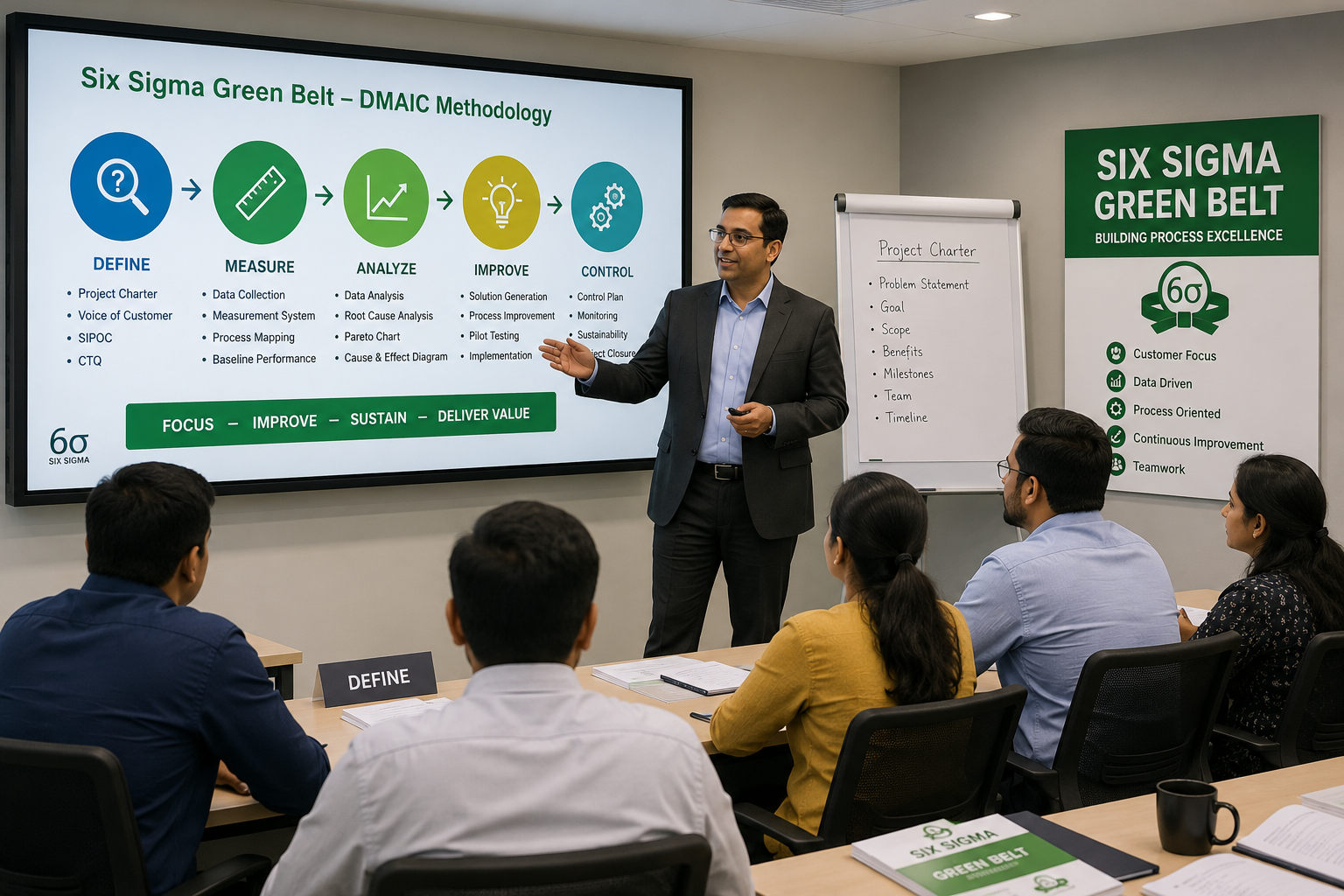
Six Sigma Green Belt International Certification Online Training Program From ASQ
-
 By
Admin
By
Admin
- 20/Jun/2026
- 0 Students
Course Description
Six Sigma Green Belt – Introduction :
Six Sigma Green Belt is a professional certification that teaches individuals how to improve business processes, reduce defects, increase quality, and enhance customer satisfaction using the Six Sigma methodology.
A Green Belt professional works on process improvement projects and supports organizational quality initiatives by applying data-driven problem-solving techniques.
Key Objectives
- Improve process quality and efficiency
- Reduce errors, defects, and waste
- Increase customer satisfaction
- Enhance productivity and cost savings
- Support continuous improvement initiatives
Benefits of Six Sigma Green Belt Certification
- Improves Career Opportunities
- Recognized globally across industries.
- Enhances your professional profile and employability.
- Higher Salary Potential
- Certified professionals often qualify for better-paying roles and promotions.
- Strong Problem-Solving Skills
- Learn to identify root causes and solve business problems systematically.
- Process Improvement Expertise
- Gain the ability to improve quality, efficiency, and productivity.
- Reduces Costs and Waste
- Learn techniques to eliminate defects, rework, and non-value-added activities.
- Better Decision-Making
- Use data and statistical tools to make informed decisions.
- Leadership Development
- Lead process improvement projects and support organizational goals.
- Increased Customer Satisfaction
- Improve product and service quality by reducing errors and delays.
- Applicable Across Industries
- Valuable in manufacturing, healthcare, IT, construction, logistics, banking, and service sectors.
- Global Recognition
- Six Sigma certifications are respected by organizations worldwide.
- Continuous Improvement Mindset
- Develop a culture of quality, efficiency, and operational excellence.
Career Roles After Six Sigma Green Belt :
- Quality Engineer
- Process Improvement Specialist
- Operations Manager
- Project Coordinator
- Quality Analyst
- Production Supervisor
- Business Process Analyst
- Continuous Improvement Professional
Six Sigma Green Belt Course Outline :
Module 1: Introduction to Six Sigma
- What is Six Sigma?
- History and Evolution of Six Sigma
- Six Sigma Methodologies
- Roles and Responsibilities (Yellow Belt, Green Belt, Black Belt)
- Benefits of Six Sigma
Module 2: Lean Six Sigma Fundamentals
- Lean Principles
- Types of Waste (TIMWOODS)
- Value Stream Mapping (VSM)
- Continuous Improvement Culture
Module 3: Define Phase (DMAIC)
- Project Selection
- Voice of Customer (VOC)
- Critical to Quality (CTQ)
- SIPOC Diagram
- Project Charter Development
- Stakeholder Analysis
Module 4: Measure Phase
- Process Mapping
- Data Collection Planning
- Measurement System Analysis (MSA)
- Basic Statistics
- Process Capability Analysis
- Control Charts Introduction
Module 5: Analyze Phase
- Root Cause Analysis
- Fishbone Diagram (Ishikawa)
- 5 Why Analysis
- Pareto Analysis
- Hypothesis Testing
- Failure Mode and Effects Analysis (FMEA)
Module 6: Improve Phase
- Solution Generation Techniques
- Brainstorming Methods
- Kaizen Events
- Pilot Testing
- Risk Assessment
- Cost-Benefit Analysis
Module 7: Control Phase
- Control Plans
- Standard Operating Procedures (SOPs)
- Visual Management
- Statistical Process Control (SPC)
- Sustaining Improvements
- Project Closure
Module 8: Statistical Tools for Green Belt
- Descriptive Statistics
- Probability Concepts
- Confidence Intervals
- Regression Analysis
- Correlation Analysis
- ANOVA Basics
Module 9: Lean Tools
- 5S Methodology
- Kanban
- Poka-Yoke (Mistake Proofing)
- SMED
- Standard Work
- Visual Workplace
Module 10: Six Sigma Project Management
- Project Planning
- Team Management
- Change Management
- Communication Planning
- Leadership Skills
Module 11: Software Applications
- Microsoft Excel for Six Sigma
- Minitab Basics
- Data Analysis Techniques
- Dashboard Reporting
Module 12: Green Belt Certification Project
- Real-Life Improvement Project
- DMAIC Application
- Project Presentation
- Certification Assessment
Who Should Attend Six Sigma Green Belt Training?
The Six Sigma Green Belt course is suitable for:
- Quality Engineers and Quality Managers
- Production and Manufacturing Engineers
- Process Improvement Professionals
- Operations Managers and Supervisors
- Project Managers
- Industrial Engineers
- Supply Chain and Logistics Professionals
- Maintenance and Reliability Engineers
- Healthcare Professionals
- Service Industry Professionals
- Business Analysts
- Team Leaders and Department Heads
- Continuous Improvement Practitioners
- Consultants
- Fresh Graduates seeking a career in Quality Management
Ideal for Professionals Working In:
- Manufacturing
- Automotive
- Oil & Gas
- Construction
- Aerospace
- Healthcare
- Information Technology (IT)
- Banking and Financial Services
- Telecommunications
- Logistics and Supply Chain
Learning Outcomes :
After completing this course, participants will be able to:
- Lead Six Sigma improvement projects.
- Apply DMAIC methodology effectively.
- Analyze process data using statistical tools.
- Reduce defects and process variation.
- Improve quality, productivity, and customer satisfaction.
- Support organizational continuous improvement initiatives.