



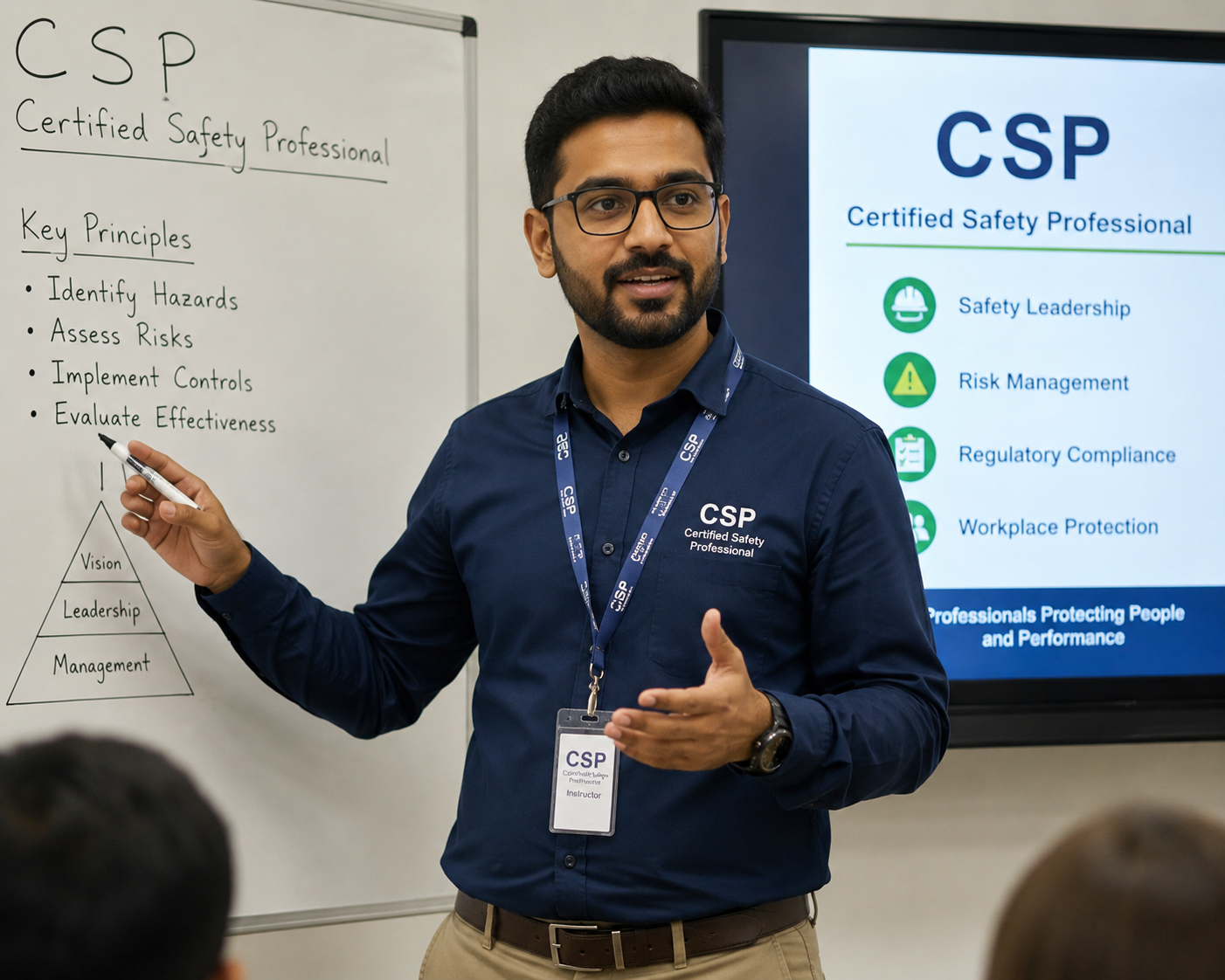
Certified Safety Professional (CSP) International Certification Online Training Program
-
 By
Admin
By
Admin
- 20/Jun/2026
- 0 Students
Course Description
Certified Safety Professional (CSP) – Introduction :
The Certified Safety Professional (CSP) is a highly respected professional certification in the field of occupational health and safety. It is awarded to experienced safety practitioners who demonstrate advanced knowledge and skills in managing workplace safety, risk control, and environmental health systems.
Purpose of CSP
The CSP certification is designed to:
- Validate advanced competency in safety management
- Improve workplace health and safety standards
- Reduce occupational hazards and incidents
- Promote leadership in safety programs
Awarding Body
The CSP credential is administered by the Board of Certified Safety Professionals (BCSP), a globally recognized organization in the safety profession.
Board of Certified Safety Professionals (BCSP)
A CSP professional typically works in:
- Risk assessment and hazard control
- Occupational health and industrial hygiene
- Safety management systems (SMS)
- Emergency preparedness and response planning
- Environmental safety compliance
Eligibility :
To pursue CSP certification, candidates usually need:
- A relevant safety-related degree or equivalent experience
- Prior safety certification (often ASP or equivalent)
- Professional experience in safety roles
Why CSP is Important
- Globally recognized safety qualification
- Strong career growth in industries like construction, oil & gas, manufacturing, and aviation
- Higher responsibility roles such as Safety Manager, HSE Lead, or Risk Consultant
- Improved earning potential and professional credibility
Benefits of Certified Safety Professional (CSP)
The Certified Safety Professional (CSP) credential is one of the most respected qualifications in occupational safety and health. It offers strong advantages for both career growth and workplace impact.
Certified Safety Professional (CSP)
1. Global Career Recognition
CSP is widely recognized across industries such as construction, oil & gas, manufacturing, aviation, and healthcare. It helps professionals qualify for international safety roles.
2. Better Job Opportunities
Holding a CSP increases chances of being selected for senior positions like:
- Safety Manager
- HSE Lead / Officer
- Risk Manager
- EHS Consultant
3. Higher Salary Potential
CSP-certified professionals generally earn higher salaries compared to non-certified safety officers due to advanced expertise and credibility.
4. Strong Knowledge & Skills
The certification builds advanced understanding in:
- Risk assessment and hazard control
- Safety management systems
- Incident investigation
- Occupational health and compliance
5. Leadership Growth
CSP helps professionals move into leadership roles where they can design and manage safety programs rather than only implement them.
6. Improved Workplace Safety Impact
CSP professionals contribute to:
- Reducing accidents and incidents
- Improving compliance with safety laws
- Building a strong safety culture in organizations
7. Professional Credibility
It demonstrates commitment, competence, and seriousness in the safety profession, making you more trusted by employers and clients.
CSP (Certified Safety Professional) – Course Outline
The Certified Safety Professional (CSP) exam is based on the BCSP blueprint and is divided into 9 major knowledge domains covering advanced occupational safety, health, environment, and management systems.
CSP Course Outline :
1. Advanced Sciences & Mathematics
- Engineering math basics
- Fluid mechanics & ventilation concepts
- Heat stress calculations (WBGT)
- Physics and chemistry applied to safety
2. Safety Management Systems
- Safety policies and procedures
- ISO 45001 / ANSI Z10 systems
- Auditing and performance measurement
- Safety leadership and communication
3. Risk Management
- Hazard identification methods (JSA, HAZOP)
- Risk assessment & evaluation
- Risk control hierarchy
- Risk communication & decision-making
4. Advanced Safety Concepts
- Hierarchy of controls
- Machine guarding & engineering controls
- Process safety management (PSM)
- Fire safety, LOTO, confined space safety
5. Emergency Preparedness, Fire & Security
- Emergency response planning
- Incident command system (ICS)
- Fire prevention & protection systems
- Disaster and crisis management
6. Occupational Health & Ergonomics
- Toxicology (LD50, exposure limits)
- Industrial hygiene & exposure monitoring
- Noise, chemical, and radiation hazards
- Ergonomics and human factors
7. Environmental Management
- Waste management & pollution control
- Environmental compliance (EPA-type systems)
- Spill prevention and cleanup
- Sustainability principles
8. Training & Education
- Safety training program design
- Adult learning principles
- Competency development
- Evaluation of training effectiveness
9. Law, Ethics & Professional Responsibility
- Regulatory compliance concepts
- Legal liability in workplace safety
- Ethical decision-making
- Professional conduct standards
Exam Structure (Quick View)
- Multiple-choice exam (computer-based)
- Scenario-based questions
- Covers all 9 domains mixed (not separate sections)
- Emphasis on application, not memorization
Key Focus of CSP Course
- Risk-based thinking
- Safety leadership & decision-making
- Real workplace scenarios
- System-based safety management
Who Should Attend CSP (Certified Safety Professional)?
The Certified Safety Professional (CSP) is designed for experienced professionals who are already working in occupational health and safety and want to move into senior or expert-level roles.
1. Safety Officers / HSE Officers
Professionals already working in:
- Construction safety
- Industrial safety
- Oil & gas sites
- Manufacturing plants
They pursue CSP to upgrade to senior safety roles.
2. Safety Engineers & Supervisors
Those responsible for:
- Risk assessment
- Safety system implementation
- Site inspections and audits
CSP helps them move into management and leadership positions.
3. Safety Managers / EHS Managers
Already in mid-level roles who want:
- Higher authority
- Global recognition
- Advanced technical expertise
4. Industrial & Plant Professionals
Engineers or managers in:
- Production
- Maintenance
- Operations
5. Health, Safety & Environmental (HSE) Professionals
Those handling:
- Occupational health
- Environmental compliance
- Risk management systems
6. Experienced Safety Graduates
Candidates with:
- Safety diploma/degree (or equivalent experience)
- Prior safety certification (like ASP or similar)
- Several years of field experience
Ideal Candidate Profile
CSP is best suited for people who:
- Already have real safety work experience
- Want senior-level career growth
- Aim for international safety certification
- Work in high-risk industries