



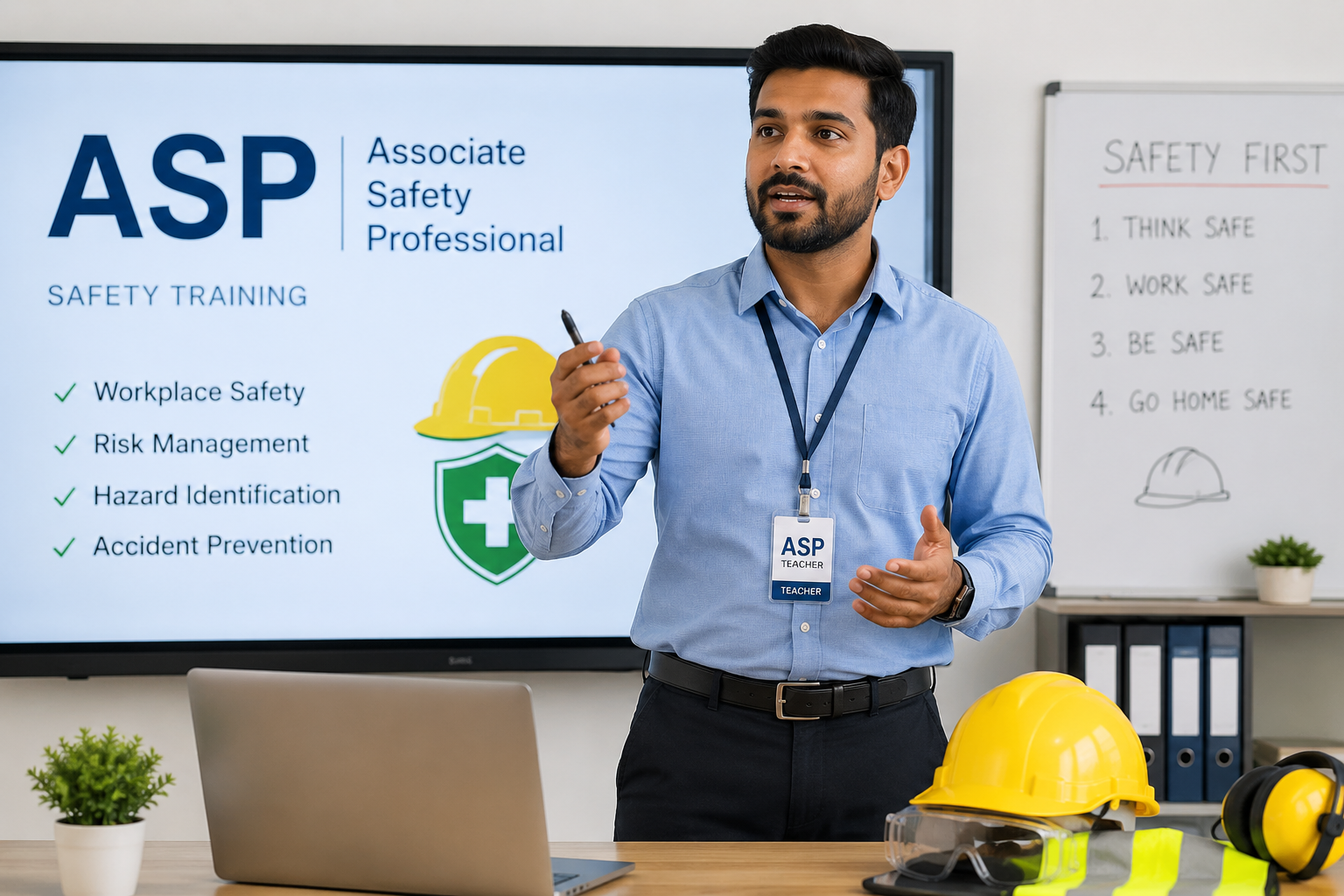
Associate Safety Professional (ASP) International Certification Online Training Program
-
 By
Admin
By
Admin
- 20/Jun/2026
- 0 Students
Course Description
ASP (Associate Safety Professional) – Introduction :
Associate Safety Professional (ASP) is a globally recognized entry-level certification in the field of Occupational Health and Safety (OHS), awarded by the Board of Certified Safety Professionals (BCSP).
It is designed for professionals who want to build a strong career in workplace safety, risk management, and environmental health (HSE).
What is ASP?
ASP is a certification that proves a person has knowledge of:
- Workplace safety systems
- Hazard identification and control
- Risk assessment techniques
- Safety regulations and compliance
- Emergency response planning
Purpose of ASP
The main purpose of ASP is to:
- Improve safety standards in workplaces
- Reduce accidents and injuries
- Train professionals in safety leadership
- Act as a foundation for advanced certification like CSP (Certified Safety Professional)
Who should attend ASP?
ASP is suitable for:
- Safety officers
- HSE engineers
- Industrial workers in safety roles
- Fresh graduates in safety/environmental fields
- Professionals aiming for global safety certification
Career Scope :
After ASP certification, you can work in:
- Construction companies
- Oil & gas industries
- Manufacturing plants
- Chemical industries
- Safety consultancy firms
ASP = A professional safety certification that helps you become a qualified safety officer/manager in industries worldwide.
ASP (Associate Safety Professional) is a certification in the field of occupational health and safety, offered by the Board of Certified Safety Professionals.
Benefits of ASP Certification :
1. Strong Career Foundation in Safety
ASP is often the first major step toward advanced certifications like CSP (Certified Safety Professional). It builds a solid base in safety management and risk control.
2. Better Job Opportunities
Holding an ASP certificate improves chances of getting jobs in industries like construction, oil & gas, manufacturing, and chemical plants.
3. Global Recognition
ASP is internationally recognized, making it easier to apply for safety roles in different countries.
4. Higher Salary Potential
Certified safety professionals generally earn more than non-certified professionals due to their verified knowledge and skills.
5. Pathway to CSP Certification
ASP is one of the main eligibility requirements for CSP, which is a higher-level safety qualification.
6. Improved Safety Knowledge
It enhances understanding of:
- Hazard identification
- Risk assessment
- Accident prevention
- Safety regulations and compliance
7. Professional Credibility
It shows employers that you are serious and qualified in occupational safety practices.
ASP – Who Should Attend?
The ASP (Associate Safety Professional) certification is mainly designed for people working in occupational health and safety (EHS/HSE) roles or planning to enter this field.
Who Should Attend :
1. HSE / Safety Professionals
- HSE Officers
- Safety Officers
- Safety Supervisors
- EHS Engineers
- Safety Coordinators
2. Managers & Supervisors in Safety Field
- HSE Managers
- Safety Managers
- Site Safety Leads
- Project Safety Supervisors
3. Engineers & Technical Professionals
- Industrial / Mechanical / Chemical Engineers working in safety roles
- Construction engineers involved in site safety
- Process safety professionals
4. Beginners in Safety Career (with eligibility)
- Graduates with a bachelor’s degree in any field
- Or diploma/associate degree in safety, health, or environment (with required subjects)
- Professionals with at least 1 year safety-related experience
5. Career Switchers into Safety
- People moving from operations, manufacturing, construction, oil & gas, or engineering into safety roles
- Employees responsible for risk assessment, hazard control, or compliance duties
ASP (Associate Safety Professional) – Course Outline :
The ASP (Associate Safety Professional) exam is based on the official blueprint of the Board of Certified Safety Professionals and is designed to test core knowledge in workplace safety, health, and environmental management.
1. Advanced Sciences & Mathematics :
- Basic mathematics used in safety
- Algebra and formulas
- Probability and statistics
- Safety calculations (risk, exposure, rates)
2. Safety Management Systems :
- Safety program development
- Hazard identification & risk assessment
- Incident investigation
- Safety performance measurement
- Safety culture and leadership
3. Ergonomics :
- Human factors in workplace design
- Manual handling and lifting safety
- Repetitive strain and posture risks
- Workplace design improvements
4. Fire Prevention & Protection :
- Fire science (fire triangle/tetrahedron)
- Flammable materials and chemical fire risks
- Fire detection & alarm systems
- Fire suppression systems (extinguishers, sprinklers)
- Hot work safety (welding, cutting)
5. Emergency Response Management :
- Emergency planning & procedures
- Evacuation systems
- Workplace violence response
- Disaster and crisis management
6. Industrial Hygiene & Occupational Health :
- Chemical hazards & toxicology
- Biological hazards (bacteria, viruses, mold)
- Exposure limits (TLV, PEL, STEL)
- Noise, radiation, heat & cold stress
- Routes of exposure (inhalation, skin, ingestion)
7. Environmental Management :
- Waste management & pollution control
- Air, water, and soil protection
- Environmental regulations
- Sustainability practices
- Environmental impact control
8. Training, Education & Communication :
- Safety training methods
- Adult learning principles
- Safety awareness programs
- Communication techniques
- Competency assessment
9. Law & Ethics :
- Workplace safety laws and regulations
- Employer responsibilities
- Ethical practices in safety profession
- Compliance standards
Exam Format :
- 200 multiple-choice questions
- 5 hours duration
- Computer-based exam
- 175 scored questions (25 unscored)
- Closed-book exam